Friday, 3 June 2011
Ami banglay gaan gai - All time best a Bangla song
Ami banglay gaan gai - a all time best bangla song. Originally Protul Mukhopadhay is the lyricist, composer and singer of this bangla song.He is a poet,a singer since the late sixties and a active socialist activist in West Bengal of India. He was born in Barisal in Bangladesh in 1942. But Mahmuduzzaman Babu made this masterpiece song popular all over the world among the Bangali community.Ami banglay gaan gai was one of the best and hit song in his first album ''Chokh vese jay jole''.This song must be an asset of profound love for each and every Bangla speaking person.
This song has become a expression of feelings that aimed at rediscovering the identity of Bangla speaking people all over the world.My hat off salut to both of the singers and all those who like and love this great song.

Wednesday, 25 May 2011
Lonely Planet - Bangladesh is the best Value Destination for 2011
 |
| Khagrachori |
Lonely Planet - one of the leading travel guide company, now owned by BBC Worldwide has ranked Bangladesh as the best Value Destination in the world for 2011. It has listed nine other countries/cities for making the list of top ten. Behind Bangladesh stand Nicaragua, Washington D.C., Paris, Namibia,Philippines, Argentina, Naples, Ukraine and Syria.
As a turist destination Lonely Planet recomends Bangladesh, specially to that turist group those who want a beautiful and a cheap destination. Many other countries have and can offer cheap service. But one thing people say often and obviously they experience that cheap is not always good. Regarding this point Lonely planet says in their briefing that it should not be perceived as one containing only ''cheap''destination. Rather,the list is based on travellers ''getting their money's worth''. So within a economic budget when travellers in Bangladesh, they not only pay a small amount of money, but also get as return a high quality of service and commodity, see worthy places. They describe Bangladesh as a ''can-do country of open-hearted people, tigers, tea plantations and the world's longest sea beach''.
 |
| Tiger in Sundarbans |
Lonely Planet is renowned for its first-hand approach, upto date maps and commitment to providing the best information for travellers. Their authors are experienced, insightful travel experts. They personally research the places they write about - both in the first and in subsequent editions - and provide essential travel details along with a wealth of insider information and first-hand tips.
For the year 2009 Bangladesh was named as one of the 10 Interesting Destinations by Lonely Planet.
Lonely Planet has their own tv channel, travel guide book publications, mobile phone apps, experienced staff, authors and 600,000 - strong online community to present the best places to go and things to do around the world to its readers.
 |
| Sitakunda eco park |
Lonely Planet to its website as introduction to Bangladesh describes as a ''trend-setting breathtaking and hard working'' country that others can learn from.
Bangladesh is one of the few countries in the world that was not affected by the recent global recession. Today, Bangladesh boasts of shipbuilding capability and is looking forward to becoming a regional communication hub. Success can also be seen in many sectors in Bangladesh , like leather, pharmaceuticals and jute manufacturing. Agriculture is , of course, already a success in many ways. And human development is also noteworthy.
 Lonely Planet says that a traveller will be rewarded most and get the maximum ''value for his
Bangladesh is waiting for you, those who want to discover and meet Bangladesh. Backpack and travel to Bangladesh. See you then some where in Bangladesh.
S: lonelyplanet.com/bangladesh;thedailystar.net(5 nov2010);defence.pk; thefinancialexpress-bd.com(3 jan2011)
Read also: Jahaj Bari or boat house(Chistia Palace): amazing architecture on Dhanmondi lake side
Sunday, 22 May 2011
Night jasmine or coral jasmine(shiuli/shefali ful) of Bangladesh

Night jasmine plant or shiuli/shefali ful gaash
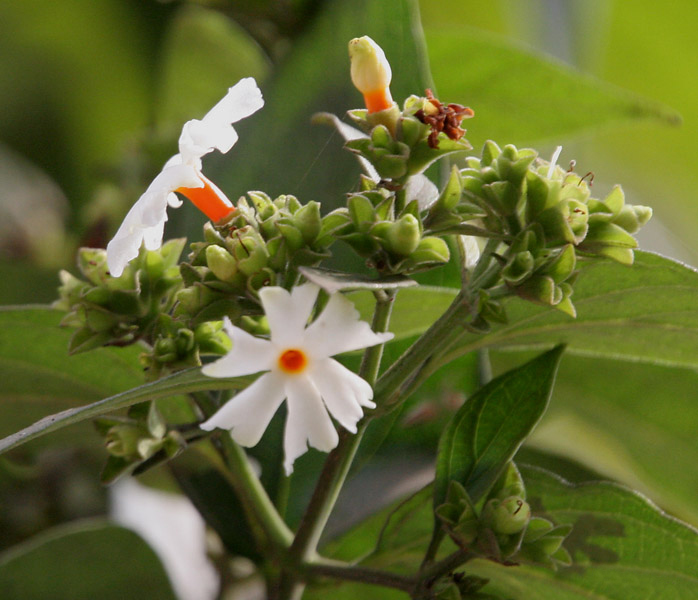 |

Night jasmine flower or shiuli/shefali ful
 |
| Heap of night jasmine flower or shiuli/shefali ful |
 |
| Night jasmine flower bud or shiuli/shefali ful er kuri |
 |
| Leaves of night jasmine flower(shiuli/shefali ful) |
 |
| Heap of night jasmine flower or shiuli/shefali ful |
 |
| Night jasmine flower or shiuli ful have fallen from the tree early in the morning |
 |
| Night jasmine flower's fruit or shiuli/shefali ful er fal
|
Coral jasmine commonly known as night jasmine is known in Bangladesh as shiuli ful.People call it as shefali ful also. Night jasmine or shiuli ful is a highly perfumed flower.The tree is sometimes called the ''tree of sorrow'',because the flowers lose their brightness during daytime. Its scientific name is Nyctanthes arbor-tristis. It belongs to Family:Oleaceae; Genus:Nyctanthes; Species: N. arbor-tristis.
Night jasmine or shiuli ful is native to southern Asia. It grows in Bangladesh, as well as in India, Pakistan, Nepal, Thailand, Malaysia, Indonesia and other countries. It is a tropical plant. The flower is the official flower of the state of West Bengal, India and for Kanchanaburi Province,Thailand.
The night jasmine tree or shiuli ful tree can be tall up to 10 meters with a flaky grey bark. Leaves of the tree are opposite,simple,6-12 cm long and 2-6,5 cm wide, with an entire margin.Large attractive leaves are rough and hairy like sandpaper.Night jasmine or shiuli ful is a sweet scented flower and small in size, 2,5-5 cm, attractive shape, with white corolla and an orange-red tube in center; they are produced in clusters of two to seven together. The flowers bloom profusely, opening at night and casting off in the very early morning. The fruit is a flat brown heart-shaped to round capsule 2 cm diameter, with two sections each containing a singel seed.
Night jasmine or shiuli ful has a important place in Ayurvedic treatment.Even the flowers have been used as a source of yellow dye for clotning.Hindus and Buddhist use this flower for worship to God.In Bangladesh children use night jasmine or shiuli ful to make garlands.
This flower is more known for its important place in Hindu mythology and the romantic story behind it. According to mythology, this is a heavenly tree brought to earth by the god Krishna. A quarrel over it ensued between Satyabhama and Rukmini, Krishna's wives.But Krishna planted the tree in Satya bhama's courtyard in a way that when the tree flowered, the flowers fell in Rukmini's courtyard. Another romantic story woven around the tree is about Parijataka, a princess. She fell in love with the sun but when he deserted her she committed suicide and a tree sprung from the ashes. Unable to stand the sight of the lover who left her, the tree flowers only at night and sheds them like tear-drops before the sun rises.But these are apparently only flowers that Hindus offer to God picked from the ground instead of plucking from the tree.
S:en.wikipedia.org; rareflora.com; toptropicals.com; worldagroforestrycentre.org; flickr.com .
Kadam/Kadambo is a rainy season flower in Bangladesh
Water hyacinth (Kochuripana) beauty and death
Silk Cotton tree - Shimul ful/ Shimul Tular Gash
Saturday, 14 May 2011
Floating garden-uses of water hyacinth (kochuripana) Bangladesh way to solve the problem
 |
| Mula river in Maharashtra,India full with water hyacinth |
Water hyacinth known as Kochuripana in Bangladesh is a tropical free-floating aquatic plant. It grows all over the world-tropical,subtropical areas of the world. It is now found in more than 50 countries on five continents.
Water hyacinth is a very fast growing plant. Now a days it is known as a ''noxious weed''. Due to this plant many countries face a lot of problems.This plant is a threat to the water eco system.Fish cannot breath and boats can not travel when a pond or river is covered by the water hyacinth or kochuripana.The blooms of the hyacinth also provide a breeding place for insects and diseases.Many people in different countries are now working to find new uses for water hyacinth(kochuripana).I mention here in very brief a number of possible uses for the plant, some which have been developed and others which are still in their infancy or remain as ideas only.
 |
| Furniture made of water hyacinth |
There are all kinds of things the weed is good for after it is harvested.
Women in Fiji weave baskets with dried water hyacinth(kochuripana).Now people are making furniture from water hyacinth. Even in Philippine and India it is also used to make basket and goods for the tourist industry.Countries that export a lot of water hyacinth furniture include Thailand, Vietnam, and Indonesia. A few examples (on the above) of how this material is used in making contemporary furniture.
The Mennonite Central Committee of Bangladesh has been experimenting with paper production from water hyacinth(kochuripana) for some years. But the result is not economically viable. Papers quality is not so good.In Uganda people use water hyacinth to make paper and mat.The quality of paper is low and is used for making folders, boxes etc.
Water hyacinth is used to make fiber board, yarn and rope in a small scale. To produce biogas from water hyacinth is also under experiment. The technology is not fully successful to operate like this project commercially.
In some parts of Bangladesh people use water hyacinth in different ways. We can call it ''floating garden''. People make heap with water hyacinth, when decayed, make wonderful fertiliser for cropping.Moreover,some crops and vegetables grow luxuriously on the dressed water hyacinth heaps. This has attracted many landless peasants to accumulate and heap water hyacinth(kochuripana) to make floating fields for agricultural production.
S: en.wikipedia.org; farmradio.org/english; ehow.com; practicalaction.org/search;
forums.permaculture.org.au/showthread.php?5544-Possible-practical-applications-of-Water-Hyacinth
Read also: Water hyacinth(kochuripana) beauty and death
Read also: Water hyacinth(kochuripana) beauty and death
Saturday, 7 May 2011
Water hyacinth(kochuripana) beauty and death


Kenyan govt. spends 290 million Ksh to destroy water hyacinth from Lake Victoria-2011

Lake Okeechobee in Florida in USA

Water hyacinth in Bangladeshis known as Kochuripana. It is a tropical floating aquatic plant. Its scientific name is Eichornia crassipes. Of its Genus has seven variant species. Its origin in Latin America. Then it spread out gradually all over the world. Water hyacinth grows and spreads rapidly in fresh water. Just imagine, a singel plant under ideal conditions can produce 3000 others in 50 days and can cover an area of 600 sq meters in a year.
Water hyacinth or Kachuripana was introduced from its native home South America to various countries as well as in the USA in the 1880's, in Australia in 1890's, in Africa in 1950's and in Bangladesh sometime in the latter part of the 19th century.
Water hyacinth(Kachuripana) plant is a free-floating aquatic plant that sends down a large bunch of long fibrous roots from a leafy main stem. Its dark green leaves are 10-20 cm across and float above the water surface. They have long, spongy and bulbous stalks. Water hyacinth(Kochuripana) plant size ranges from a few cm to a meter in hight. The flower of this plant develop on a spike and have six individual petals that join at the bottom to produce a tube-like bloom. The colour of these flowers vary from a lighter shade of blue to violet with a yellow marking-like eyr or spot on the petals.
Still now water hyacinth(Kochuripana) is a problem in the USA. In the beginning they used arsenic to destroy and wipe out this plant and could partially clear the weeds but poisoned the ecosystem. They tried also with fire and explosives. In Africa lake Victoria's many areas are now paralyzed due to this plant.
In Bangladesh water hyacinth(Kochuripana) was also a very big problem. Water ways were blocked and nevigation were almost impossible. In the provincial election in 1937 all the major political parties promised to eradicate the water hyacinth. After the election the politicians kept their words and that worked. Now in Bangladesh water hyacinth(Kochuripana) is not seen as a problem, it still exists in haors and beels.
If you make a heap of water hyacinth(Kochuripana), when decayed, make wonderful fertilizer for cropping.Moreover, some crops and vegetables grow luxuriously on the dressed water hyacinth (Kochuripana) heaps. This has attracted many landless peasants to accumulate and heap water hyacinth(Kochuripana) to make floating fields for agricultural production.
S:en.wikipedia.org; water-hyacinth.com; banglapedia.org; aquaticcommunity.com; naturia.per.sg/buloh/; wiki.bugwood.org/archive:bcipeus/eichhornia_crassipes; environment.go.ke .
Read also: Floating garden-uses of water hyacinth(kochuripana)Bangladesh way to solv the problem
Sunday, 1 May 2011
ICC Trophy Final '97- after that day Bangladesh cricket entered to a new era
Its really hard to understand today that the ICC Trophy Final Match in 1997 how much important was for the Bangladesh cricket. After that final match Bangladesh cricket entered to a new era and cricket world saw that tournament gave birth to a tiger cub. That win led to Bangladesh to their first ever World Cup and the eventual ascension as a Test playing nation.
Match was played at Tenaga National Sports Complex, Kuala Lampur in Malayasia on the 12,13 April 1997. Bangladesh played against Kenya and it was 50 overs match. Bangladesh won toss and chose to field first. Kenya played 50 overs and made 241 runs with 7 wickets. Torrential rain began before Bangladesh innings. Umpires decided that match could be played on the next reserve day. But the outfield was not fit for the match. Groundsmen and Bangladeshi players all together worked hard to make the outfield fit for the match. At last umpires decided to continue the match in cartel overs. Bangladesh target was reduced to 166 in 25 overs(that is 332 runs in 50 overs) under the Duckworth - Lewis calculation.
Bangladesh squad was Naimur Rahman Durjoy, Mohammed Rafique, Minhajul Abedin Nannu, Aminul Islam Bulbul, Akram Khan, Enamul Haque Moni, Saiful Islam, Khaled Masud Pilot, Khaled Mahmud Sujon, Hasibul Hossain Santo and Athar Ali Khan. Naimur Rahman and Mohammad Rafique oppend the innings.But unfortunately Naimur Rahman was bold facing the first ball. It was very hard for the players to collect runs because of wet outfield. There were tremendous pressers on the players. Everybody tried to hit hard. Then in the last over Khaled Masud Pilot and Hasibul Hossain Santo were batting. Bangladesh needed 11 runs from that last over. Watch this exciting video clip how it became possible and Bangladesh won the match.
S: espncricinfo.com/ci/engine/match/66792.html
Monday, 25 April 2011
Alexander the Great failed to conquare Bangla region known as Gangaridai/Gangaridi
Alexander when planned to invade India, he reached first in the north of Gandhara what is now Pakistan.That region including now a days Punjab, Alexander could conquare. He defeated a local Hindu ruler Porus, who ruled in the Punjab, in 327 BC.Then Alexander decided to march forward with his army.To come upto this region Alexander crossed the rivers Indus(Shindhu), Jhelum, Chenab and Ravi and reached the shores of river Hyphasis(now a days Beas river), a distance of about 390 miles from the Indus crossing. He wanted to move further eastward to Bengal and beyond. In the beginning Alexander tried to get information about his next campign destiny and the route. He was informed that the next empeir named Gangaridai/Gangaridi and situated on the bank of the river Ganga. According to his collected information, to make the journey possible Alexander started to build big boats by the local people. He needed 800 boats to enable him and the army to sail efter the Bengal campaign. Local people built the boats and it took almost two years to be completed. Within this time Alexander and his army got sufficient information about the Gangaridai/Gangaridi nation and their empair.
East of Porus' kingdom, near the Ganges river, was the powerful Nanda Empire of Magadha (north and west Bengal were part of the Magadhan empire known to the Greeks as Prasii) and the mighty Gangaridai/Gangaridi empire of Bengal (southern part of Bengal now a days Bangladesh) . From different sources under his boat building two years time, preparation time to invade Bangla Alexander and his mighty undefeated army got information of the Gangaridai/Gangaridi empire's military strength. Alexander heard that the king of Gangaridai/Gangaridi and his army allied with porisii (Nanda) empire waiting for a counter attack with 200000 infantry, 20000 cavalry-horses, 2000 four-horsed chariots and 3000 elephants trained and equipped with arms for war.
When all preparation were completed to invade Bangla or Gangaridai/Gangaridi empire, Alexander called a general meeting with all his troops and generals.In the assembling Alexander tried to pacify the fears of his troops and persuaded them to march forward towards Bengal that times Gangaridai/Gangaridi. He appealed to their love of king, country and the Greek Gods. He tried to flowrished his troops courage and said that ''If stories could have defeted us we would have fled Asia long ago.'' The soldiers listended in silence and hung their heads.They didnot respond to the king's exhortations. Then Coenus, one of the generals came forward to speak to the king. He said to the king,''You are preparing to enter another world and seek on. India even the Indians don't know. That is a program appropriate to your sprit, but beyond ours.'' Coenus made a memorable point, that it was a noble thing to exercise self-restraint when all was going well.
Alexander was compelled to change his mind and plan when he saw that his troops and the other generals were unwilling to march forward for fighting with the Gangaridai/Gangaridi empire's army. Mean while, the ships he had ordered were ready for the journey. Alexander appointed his boyhood friend Nearchus, as the Admiral of the fleet. Then he sent much of his army with his general Craterus and admiral Nearchus towards the Persian Gulf and he led the rest of his forces back to home through Babylon.
According to the Greek writers Gangaridai/Gangaridi empair-that times Bangla rigion kept on flourishing at least upto the 1st century AD.
''Before ending this article, imagine yourself as a decendant of a mighty empire which had its glory and might to take a rightful position in the book of history.When we travell around the world usually we visit different historical places, old civilization. We take photoes and post them in internet and proudly say that I stood in the place where the mighty Ceaser, Pharaoh or Emperor stood. Funny enough when places and culture lays at our backyard unattended and forgotten. Now a days people forget their roots and heritage. I am not anti western but also I am a diehard Bangladeshi. I am not here to criticize the western culture but to promote mine. So here is a request, if you like something about being Bangladeshi be proud to share it and dicuss it''.
 |
| Statue of Alexander the Great |
Alexander III of Macedonia (356 BC -323 BC), commonly known as Alexander the Great, was a king of Macedonia, a state in the north eastern region of Greece. He was born on 20 or 21 July 356 BC in Pella, the capital of the ancient Greek kingdom of Macedonia. He was the son of king Philip II and queen Olympias. In his boyhood Alexander was tutored by the famed Greek philosopher Aristotle.
In 336 BC Alexander succeeded his father Philip II of Macedonia to the throne at the age of 20, after his father was assassinated. Philip had brought most of the city-states to mainland Greece under Macedonian hegemony, using both military and diplomatic means. Upon Philip's death, Alexander inherited a strong kingdom and an experienced army. He succeeded in being awarded the generalship of Greece and with his authority firmly established, launched the military plans for expantion left by his father. In 334 BC at the age of 22, he invaded Persian ruled Asia Minor(now a days Turkey region) and began a series of campaigns lasting ten years.By the age of thirty Alexander was the creator of the largest empires in ancient history, stretching from the Ionian sea to the Himalaya.He was undefeated in the battle and is considered one of the most successful commanders of all time. |
| Asia in 323 BC,Nanda Empire and the Gangaridi Empire |
Now a days all the histories, descriptions, stories what we find in text were written by the Greek writers and historians.Megasthenes, Arrian, Diodorus Siculus,Ptolemy, Periplus were the Greek writers, historians,geographist who wrote books about Alexander's travell,adventures and war histories. They described also about that times contemporary countries, their locations, people, their culture and custom and some other notable things.So, what I narrate here in this article all the informations are collected from their writtings.
East of Porus' kingdom, near the Ganges river, was the powerful Nanda Empire of Magadha (north and west Bengal were part of the Magadhan empire known to the Greeks as Prasii) and the mighty Gangaridai/Gangaridi empire of Bengal (southern part of Bengal now a days Bangladesh) . From different sources under his boat building two years time, preparation time to invade Bangla Alexander and his mighty undefeated army got information of the Gangaridai/Gangaridi empire's military strength. Alexander heard that the king of Gangaridai/Gangaridi and his army allied with porisii (Nanda) empire waiting for a counter attack with 200000 infantry, 20000 cavalry-horses, 2000 four-horsed chariots and 3000 elephants trained and equipped with arms for war.
When all preparation were completed to invade Bangla or Gangaridai/Gangaridi empire, Alexander called a general meeting with all his troops and generals.In the assembling Alexander tried to pacify the fears of his troops and persuaded them to march forward towards Bengal that times Gangaridai/Gangaridi. He appealed to their love of king, country and the Greek Gods. He tried to flowrished his troops courage and said that ''If stories could have defeted us we would have fled Asia long ago.'' The soldiers listended in silence and hung their heads.They didnot respond to the king's exhortations. Then Coenus, one of the generals came forward to speak to the king. He said to the king,''You are preparing to enter another world and seek on. India even the Indians don't know. That is a program appropriate to your sprit, but beyond ours.'' Coenus made a memorable point, that it was a noble thing to exercise self-restraint when all was going well.
Alexander was compelled to change his mind and plan when he saw that his troops and the other generals were unwilling to march forward for fighting with the Gangaridai/Gangaridi empire's army. Mean while, the ships he had ordered were ready for the journey. Alexander appointed his boyhood friend Nearchus, as the Admiral of the fleet. Then he sent much of his army with his general Craterus and admiral Nearchus towards the Persian Gulf and he led the rest of his forces back to home through Babylon.
According to the Greek writers Gangaridai/Gangaridi empair-that times Bangla rigion kept on flourishing at least upto the 1st century AD.
''Before ending this article, imagine yourself as a decendant of a mighty empire which had its glory and might to take a rightful position in the book of history.When we travell around the world usually we visit different historical places, old civilization. We take photoes and post them in internet and proudly say that I stood in the place where the mighty Ceaser, Pharaoh or Emperor stood. Funny enough when places and culture lays at our backyard unattended and forgotten. Now a days people forget their roots and heritage. I am not anti western but also I am a diehard Bangladeshi. I am not here to criticize the western culture but to promote mine. So here is a request, if you like something about being Bangladeshi be proud to share it and dicuss it''.
This video clip is a part of a documentary film''In the footsteps of Alexander the Great''. British film maker Michael Wood has presented this award winning film from BBC in the year 1998.To make this film Michael Wood and his group started their journey from Greece following Alexander's route and reached in India. He traveled over 20,000 miles- on everything from foot,camels and horses-to helecopters, boats and jeeps through 16 countries and four war zones.
S: en.wikipedia.org (articles on Alexander the Great, Gangaridai, Megasthenes, indica, Nearchus, Coenus); bengal unconquared by Alexander-a article in google groups; harekrsna.com/sun(features july 2009-the history of ancient bengal); wastelandersdiary.wordpress.com(article-Gangaridai).
Wednesday, 20 April 2011
Why not me
So many things happen around us. But we don't have so much time to notice all the things. Small things have also a great impact for others. All these small things will make a big thing one day. Its we,who can make the things different from our position. So, ''Ask not what your country can do for you, ask what you can do for your country.''
Saturday, 16 April 2011
Be a witness of a historical moment of Bangladesh on the 17th April 1971
History repeats itself.When Nawab Siraj-ud-Doulah had defeted at the war with the British at the Mango Grove in Palashi, Bangla region(Bangla,Bihar,Orisha) lost its freedom and was ruled over almost 200 years by the British.Then Bangla decleared its independence officially from another Mango Grove at Baidyanathtola in Meherpur.
April 17,on this day in 1971, the Mujibnagar government was formed by the elected leaders of Bangladesh --the 167 MNAs(member of national assambly) and 293 MPAs(member of provincial assembly) who composed the Constituent Assembly fullfilling their constitutional obligation to the electors, gave a true shape and constitutional perspective on this day, making the dream of an independent Bangladesh a reality.
The Mujibnagar government is also known as the Bangladesh government-in-exile.Following the military crackdown by the Pakistani military in Dhaka and elsewhere on 25 March 1971,top Awami League leaders including some elected members of both National Assembly and Provincial Assembly crossed over to India for safety.By 30 March 1971, most of them were able to assemble in Kolkata.On 10 April,1971,the MNAs and MPAs who were able to meet together in Kolkata formed themselves into a constituent assembly in exile and drafted the proclamation of Independence.
Proclamation of Independence formally announced by the Bangladesh government-in-exile on 17 April 1971.The formation of the Mujibnagar government and the proclamation of Independence of Bangladesh to the world, is really a red-letter event in our national history. The ceremony was held at Baidyanathtala(renamed Mujibnagar after the proclamation)in Vhobopara village,a border area in present Meherpur district.Bangabondhu Sheikh Mujibur Rahman,who was then interned in Pakistan was elected President,Syed Nazrul Islam Vice President,Tajuddin Ahmed Prime Minister,M.Mansur Ali Finance Minister,M.Quamruz Zaman Home Minister,Khandakar Mustaque Ahmed Foreign Minister and General M.A.G.Osmani who was then a retired colonel and MNA elected from Awami League was made the C-in-C of the Bangladesh armed forces.
A few platoons of the then EPR and freedom fighters were deployed for presenting the Guard of Honour.The ceremony started at 11 a.m. when Syed Nazrul Islam hoisted the flag,a small group sang the national anthem ''Amar Sonar Bangla''(my golden Bangla) in a chorus.Yusuf Ali, an MNA formally read out the Proclamation of Independence.Syed Nazrul Islam announced the formation of a sovereign government of Bangladesh,took the oath and introduced the ministers to the audience.Syed Nazrul Islam was appointed as Acting President and then delivered his speech. After that,Prime Minister Tajuddin Ahmed spoke at a press conference.The whole ceremony was witnessed by hundreds of foreign journalists who had assembled there to hail the birth of a new nation.
The importance of establishing Mujibnagar government was it gave ''life and legitimacy'' to the national liberation war both internally and internationally.Look at the other movements like autonomous or nationalist movements that all were stamped very easily as separist movement.But Bangladesh efforts was stamped as a nation's liberation war movement.In fact, in case of failur to be successful to establish a sovereign country the Mujibnagar government took all the responscibilities.
The nation should greatfully remember the heroic courage,conviction and determination of the politicians,the freedom fighters and the people in general who sacrificed their everything for the cause of an independent countryof our own ---A hat off salute to them.
S:en.wikipedia.org;banglapedia.org;mujibnagar.com;the daily star-april 17,2005.
Hope, Love and Bangladesh Cricket
- Despite of all failure I am with Bangladesh.I know that Bangladesh have many obstructions and problems on its way but its coming forward.I am hopefull that my country is trying to go forward.I do belive that slow and steady wins the race at last.Hope for the best.We shall overcome somedays.
Saturday, 2 April 2011
Concert for Bangladesh --The first benifit concert in the music history
 |
| Advertisement poster for movie and album |
In 1971, when George Harrison was approached by his Indian Bangali musician friend Ravi Sankar,for help for food and war ravaged Bangladesh, the concept of the superstar concert benifit didn't exit.
Ravi Sankar requested George Harrison that they should try to raise US $ 25,000 for the UNICEF fund to help the Bangladeshi refugees who took shelter in India.After hearing the details about the loss of lives and the liberation war of the common people then George Harrison stated that they must try to do something bigger than that.Thus the first concert for world humanity named today as charity or benifit concert took place on August 1,1971 at Madison Square Garden in New York in USA bannered as The Concert for Bangladesh.So in plain text we can say that The concert for Bangladesh was the first benifit concert in the modern music history.The concert raised US $243,418,51 for Bangladesh relief,which was administered by UNICEF.An album was released later in 1971 and a concert film in video was released in 1972.In 2005, the film was re-issued on DVD accompanied by a new documentary.Sales of the movie and album ultimately generated more than US$15 million. In addition, the music album of The Concert for Bangladesh also won the Grammy Award in the year 1971,it reached number 2 on the U.S. music charts and number 1 on the U.K. music charts.Sales of the album and DVD still now continue to benifit the George Harrison Fund for UNICEF.
To stage this concert George Harrison took contact with his other superstars friends,mainly the world famous previous band group ''The Beatles''.To organize this concert he could gether all the superstars in one stage.They were Ringo Starr,Eric Clapton,Leon Russell,Billy Preston,Ravi Sankar,Ustad Akbar Ali Khan,Ustad Alla Rakha Khan,Kamala Chakravarty,Klaus Voorman,British rock band Badfinger,Jesse Ed Davis,Don Preston,Carl Radle,The Hollywood Horns band group,Bob Dylon,George Harrison himself and some other performers as backing vocalists.The concert was organized within five weeks, all of the tickets were sold out(20,000 tickets were sold in two hours) and 40,000 people enjoyed the concert.
Interesting news about this concert are that,it was the first live appearance for George Harrison since the breakup of ''The Beatles''.Bob Dylan staged his last live performence in August 1969 and he was still recovering from a near-fatal motor cycle accident.Eric Clapton who was still in the grip of heroin addiction and had been unable to attend any rehearsals untill the final sound check,a day before the concert.Eric Clapton was booked on every airline flight from London to New York city for a week before the concert.George Harrison requested John Lennon to take part in the concert with a condition that Lennon's wife Yoko Ono would not perform with him.John Lennon agreed,took part in rehearsals but left New York two days before the concert following an argument with Ono regarding his and Harrison's agreement that she would not participate.
 |
| Performers of the Concert for Bangladesh |
Concert for Bangladesh established the model for many Live Aid,Live 8 and Hurricane relief super star benifit shows that followed over the next 40 years.The main success of this concert was not only raising funds but also could excel the attention of the mass people in western world and the name Bangladesh was known all over the world.Remember that in 1971 media was not so powerful like today.There was no Internet or Cable TV like now.
The Concert for Bangladesh shows that music is not only for individuals pleasure, it shows that music can stand for a common humanitarian cause - setting the precedent that music could be used to serve a higher cause.
S:en.wikipedia.org;georgeharrison.com;beatlesnumber9.com/bangladesh.html;bdtalks.com;
classicrock.about.com;amibangladeshi.org;prairieprogressive.com/2009/7/29;concertforbangladesh.com;booksmusicfilmstv.com/GeorgeHarrison.htm
classicrock.about.com;amibangladeshi.org;prairieprogressive.com/2009/7/29;concertforbangladesh.com;booksmusicfilmstv.com/GeorgeHarrison.htm
Saturday, 26 March 2011
The Miracle of Bangladesh
Hans Rosling who presents this video clip (born 27 July 1948 in Uppsala,Sweden) is a Swedish medical doctor, academic, statistician and public speaker. He is Professor of International Health at Karolinska Institute and co-founder and chairman of the Gapminder Foundation,which developed the Trendalyzer software system.This software that converts international statistics into moving, interactive graphics. His lectures using Gapminder graphics to visualise world development and changes.
Have you heard about Miracle that has happened in Bangladesh over the last 40 years? No? Bangladesh has the highest population density among the worlds big countries. Today Bangladesh has more people than Russia. But the area is smaller than Florida.
So what is the Miracle?To know about the miracle watch this video clip.
Sunday, 20 March 2011
Old Days in Pictures of Bangladesh
To see the text clearly, please watch this video clip in full screen.
Thursday, 17 March 2011
Bangla language, it's achievement and now one of the official language in Sierra Leone
 |
| Bangla speaking rigion in yellow colour |
Number of Bangla Speakers : Bangla or Bengali (বাংলা –pronounced bang-laa; baŋla) is an eastern Indo-Aryan language. It is native to the region of Eastern South Asia known as Bengal , which comprises present day Bangladesh . Bangla is the mother tongue of the people of Bangladesh .About 160 million people live now in Bangladesh. The Indian states West Bengal, Tripura, Assam-mainly southern Assam and other places of India also people speak in Bangla as their mother tongue . It is even a major language in the Indian union Territory of Andaman and Nicobar Islands(Bengali speakers make up the majority in Neil Island and Havelock Island) due to lot of settlement post 1947 migration. Now a days we can count the Bangla speaking population in India on an average 90 million .Outside Bangladesh and India, Bangla is spoken in Nepal by over 27000 people and to a lesser degree in Singapore, Malaysia, Saudi Arabia, United Arab Emirates,South Korea ,the United Kingdom,Canada and the USA .Across all countries where it is spoken an additional 5 million people speak Bangla as a second language. With nearly 255 million total speakers, Bangla is one of the most spoken language – ranking sixth (efter Mandarin, Spanish, English, Hindi and Arabic) in the world.
Bangla Script Uses in other Languages : The Bangla script has particularly close historical relationships with the Assamese script.With a few small modifications Bangla script is also used for writing Assamese.Other related languages in the region also make use of the Bangla alphabet. Meithei (Manipuri),a Sino-Tibetan language used in the Indian state of Monipur, was written in the Bangla alphasyllabary for centuries, until the 1980s, when Meetei Mayek (the Meithei alphasyllabary)returned to daily usage. For centuties, the Sylheti language used a different script, based on the Devanagari alphasyllabary. This script called Syiheti Nagori, has now fallen out of use, as most speakers of Sylheti have adopted the Bangla script .Even in Tripura(Indian States) another major language Tripuri also known as Kak- Barak, belongs to the Tibeto-Burman group of languages(root can be traced from Sino-Tibetan speech family) does not possess any writing script. This language also uses the Bangla script for writing.
 |
| Bangla alphabets |
Spread of Bangla, Official Status and achievement : Bangla is the national and official language of Bangladesh. Bangla is also one of the 23 national languages recognized by the Republic of India. It is the official language of the state of West Bengal and co-official language of Tripura, Assam which has three predominantly Sylheti speaking districts – Cachar, Karimganj and Hailakandi of southern Assam and the union territory of Andaman and Nicobar Islands.
In 1999,UNESCO decided to celebrate every 21 February as International Mother Language Day in recognition of the deaths of the language martyrs.
 |
| President Alhaj Ahmed Tejan Kabbah |
It is also remarkable that the government of Sierra Leone declared Bangla as one of the several official languages in the country. On the 12th December, 2002 the President of Sierra Leone Alhaj Ahmed Tejan Kabbah(born February 16, 1932 ;3rd President of Sierra Leone, serving from 1996 to 1997 and from 1998 to 2007. He worked for the United Nations Development Programme and returned to Sierra Leone in 1992.) announced this decision while inaugurating a 54 km long rebilt road. This road was reconstructed by the engineering corp of Bangladesh Army – Bangladeshi peacekeepers in the West African country. So Bangla was made an official language of Sierra Leone in order to honor the Bangladeshi peacekeeping force from the United Nations stationed there.
When from 1947 to 1971 Bangladesh and Pakistan were one nation(and were called East and West Pakistan), the central government tried to establish Urdu(spoken in West Pakistan)as sole national language.On February 21,1952,protesting students and activists were fired upon by military and police in Dhaka University and several students and activists were killed. But the government had to give in after massive protests and gave Bangla official status.
 |
| Language movement martyrs sculpture |
 |
| Language martyrs monument-Shaheed Minar |
And at last I like to say that Rabindranath Tagore(1861-1941), the first Asian author who won the Nobel Prize in Literature was a Bangali poet and writer, wrote the national anthems of both India and Bangladesh in Bangla.
S:en.wikipedia.org;mybengali.com;joutho.wikidot.com;bangladeshcanadaandbeyond.blogspot.com; voanews.com(27-12-2002);bangalnama.wordpress.com/2008/09
Tuesday, 15 March 2011
Jambul(Jaam/Jam/Kalojaam) is one of the desirable summer fruit in Bangladesh
 |
| Ripe Jambul/Jamun or Jambolan (Jam/Jaam /Kalojaam) |
 |
| Ripe Jambul/Jamun or Jambolan (Jam/Jaam /Kalojaam) |
 |
| Green and ripe Jambul/Jamun or Jambolan (Jam/Jaam /Kalojaam) |
 |
| Jamblang/Jambula or Black plum(Jam/Jaam /Kalojaam) in the tree |
 |
| Jambul/Jamun or Jambolan (Jam/Jaam /Kalojaam) leaves |
 |
| Jamblang/Jambula or Black plum(Jam/Jaam /Kalojaam)hanging in the tree |
 |
| Green and ripeDuhat Plum,Java Plum or Portuguese Plum(Jam/Jaam /Kalojaam) |
 |
| Jambul/Jamun or Jambolan (Jam/Jaam /Kalojaam) flowers |
 |
| Blooming Jambul/Jamun or Jambolan (Jam/Jaam /Kalojaam) flowers |
 |
| Yielding Jambul/Jamun or Jambolan (Jam/Jaam /Kalojaam)and flowers |
 |
| Green young Jambul/Jamun or Jambolan (Jam/Jaam /Kalojaam) fruits |
 |
| Green and mature Jambul/Jamun or Jambolan (Jam/Jaam /Kalojaam) with leaves |
 |
| Ripe Duhat Plum,Java Plum or Portuguese Plum(Jam/Jaam /Kalojaam) |
 |
| Jambul/Jamun or Jambolan (Jam/Jaam /Kalojaam) seeds |
 |
| Jambul/Jamun or Jambolan (Jam/Jaam /Kalojaam) tree bark |
 |
| Jambul/Jamun or Jambolan (Jam/Jaam /Kalojaam) tree trunk and leaves |
 |
| A line of Jambul/Jamun or Jambolan (Jam/Jaam /Kalojaam) trees |
 |
| A short size Jambul/Jamun or Jambolan (Jam/Jaam /Kalojaam) tree |
 |
| A vendor on a roadside with Jambul/Jamun or Jambolan (Jam/Jaam /Kalojaam) |
 |
| Ripe Jambul/Jamun or Jambolan (Jam/Jaam /Kalojaam) |
Jambul/Jamun or Jambolan is known as Jaam /Kalojaam in Bangladesh. This fruit is also known as Jamblang, Jambula, Black Plum, Damson Plum, Duhat Plum, Jambolan Plum,Java Plum or Portuguese Plum. Jambul/Jamun Or Jambolan (Jaam/Kalojaam) is an evergreen tropical tree. It is native to Bangladesh, India and Indonesia region. It is also grown in other areas of southern Asia including Myanmar and Afghanistan. The word 'Jambul' is sometimes mistranslated as 'Blackberry', which is a different fruit. Its scientific name is Syzygium cumini and belongs to family Myrtaceae.
The tree was also introduced to Florida, USA in 1911, and is also now commonly planted in Suriname. In Brazil, where it was introduced from India during Portuguese colonisation, it has spread out in the wild in some places also. The various names for this fruit are (in Java) plum, jambul, jamun, jaman, black plum, Indian blackberry, jambol, doowet and jambolan.
According to Hindu tradition, Rama subsisted on the fruit in the forest for 14 years during his exile from Ayodhya. Because of this, many Hindus regard Jambul as a 'fruit of the gods'. In Hindu mythology Lord Krishna has been described as having skin the color of Jambul. The leaves are used in India as marriage pendals.A fairly fast growing species, in native conditions it can reach heights of up to 25m and can live more than 100 years. Its dense foliage provides shade and is grown just for its ornamental value. Large oblong leaves are smooth, glossy, with a turpentine smell. Leaves are broad-tipped, opposite, shiny and leathery, ellipitic, 6 to 15 cm long. The Jamun tree starts flowering in March-April. The fragrant flowers of Jamun are small, nearly 5 millimetres in diameter. This is followed by the fruit which appears in May-June and resembles a large berry. The berry is oblong, ovoid and 1 to 2 cm long. It is green when just appearing, pink when as it matures, and shining crimson black when fully ripe. Jamun fruit is a mixture of sweet, slightly sub acid spicy flavour that stands out even after eaten since it turns the tongue into purple color. Its timber that is the wood of this tree is strong and water resistant. The fruit is universally accepted to be very good for medicinal purposes, especially diabetics. The seed is also used in various alternative healing systems like Ayurveda, Unani and Chinese medicine for digestive ailments. The leaves and bark are used for controlling blood pressure and gingivitis.Wien and vinegar are also made from the fruit. The flowers have abundant nectar, and the honey is of fine quality. The essential oil distilled from the leaves is used to scent soap and is blended with other materials in making inexpensive perfume.
All parts of the java plum can be used medicinally and it has a long tradition in alternative medicine.The bark has anti-inflammatory activity and is used In India for anemia, the bark and seed for diabetes which reduce the blood sugar level quickly, the fruit for dysentery and leave's juice for gingivitis (bleeding gums).In the Philippines and Suriname wine is made from the fermented fruit.In Surinam also, the whole leaves are used by women as a feminine sitz-bath to shrink the vagina after giving birth and getting rid of mucus and odors. This bath from the Jamun leaves is also used at any other time to shrink the vagina. This gives the ultimate in sexual pleasure for both partners .
The tree occurs in the tropical and sub-tropical climates under a wide range of environmental conditions and can thrive on a variety of soils. Jambul grows easy in sub-tropics and tolerates cooler winters. It prospers on river banks and has been known to withstand prolonged flooding, yet it is tolerant of drought as well. Dry weather is even more desirable during the flowering and fruiting periods. The seedlings starts fruiting in 4-7 years.
The fruit has a high source in vitamin A and vitamin C, and has received recognition in folk medicine and in the pharmaceutical trade. The seeds, leaves and bark are also used in various alternative healing systems like Ayurveda and Chinese medicine.
S: en.wikipedia.org; toptropicals.com; wonderherbs.org/syz.html; genuineaid.com
Subscribe to:
Posts (Atom)