Showing posts with label Fruits. Show all posts

Sunday, 5 June 2011

Asian Palmyra Palm/Asian Palm Fruit (Tal/Taal fal) in Bangladesh


Asian palmyra palm/Asian palm/Toddy palm tree(Tal/Taal gaas)
Asian palmyra palm/Sugar palm tree(Tal/Taal gaas) in rural Bangla

Asian palmyra palm/Asian palm tree(Tal/Taal gaas) in rural Bangla


Asian palmyra palm/Sugar palm fruit(Tal/Taal) in clusters in the tree
Asian palmyra palm in Bangladesh
Asian palmyra palm/Toddy palm fruit(Tal/Taal) in clusters in the tree
Asian palmyra palm in Bangladesh
Asian palmyra palm/Sugar palm fruit(Tal/Taal) in clusters in the tree
File:FRUIT, LEAVES & BAYA's NESTS I IMG 5108.jpg
Babui pakhi/weaver bird's nests hanging from the Asian palm (Tal/Taal) tree
Asian palmyra palm in Bangladesh
Green Asian Palmyra Palm/Asian Palm Fruit (Kochi Tal/Taal fal)
Asian palmyra palm in Bangladesh
Green Asian Palmyra Palm/Toddy Palm Fruit (Kochi Tal/Taal fal)
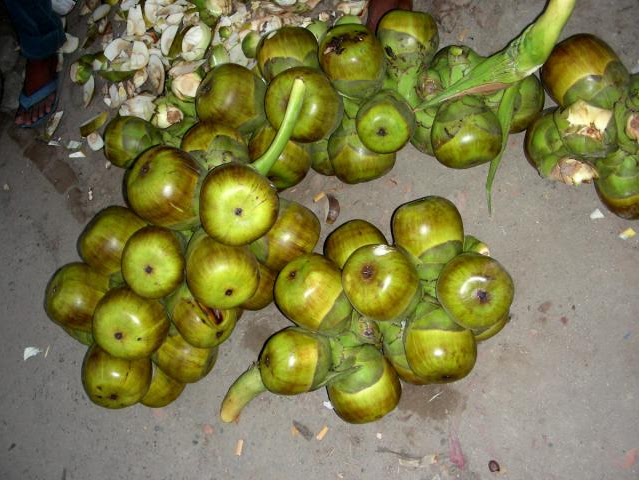
Green Asian Palmyra Palm/Sugar Palm Fruit (Kochi Tal/Taal fal)

Asian palmyra palm in Bangladesh
Green Asian Palmyra Palm Fruit's seed sockets (Kochi Tal/Taal fal)
Asian palmyra palm in Bangladesh
Green Asian Palmyra Palm Fruit's seed sockets (Kochi Tal/Taal fal)

Green Asian Palmyra Palm Fruit's jelly like seed sockets (Kochi Tal/Taal fal)


Climbing on palm(Tal/Taal) tree to collect juice
Collected palm juice(Tal/Taal ross) in earthen pots

    Ripe Toddy palm/Sugar palm/Palmyra palm(Tal/Taal)
Ripe Asian palmyra palm/Asian palm(paka Tal/Taal)


         Ripe palm(paka Tal/Taal fal) fruit with fiber and pulp and seeds

Hard seeds or stones of Asian palmyra palm fruit(Tal/Taal faler aati)

Asian palmyra palm or Asian palm is known as Tal/Taal in Bangladesh.Its scientific name is Borassus flabellifer.It belongs to Arecaceae family.It has some other english names.In english it is also known as Toddy palm, Sugar palm, Cambodian palm and Ice apple.
Asian palmyra palm(Tal/Taal) tree is a robust tree and can live 100 years or more and reach a hight  of 30 m, with a canopy of leaves several dozen fronds spreading 3 m across.Young palmyra palms(Tal/Taal) grow slowly in the beginning but then grow faster with age.Palmyra palm(Tal/Taal) is a large palm tree, usually 10 to 25 meters high, but sometimes growing up to 30 m tall.It may take 20 years until the first harvest.There are separate male and female trees.Male and female inflorescences are tapped to produce a sweet sap.
Fruits grow in clusters. The fruits are round and have a dark-brown color on the bottom part and a green color on the top. The color changes to dark-yellow when it ripens. Fruits have a diameter of 13-20 cm.When the fruits are cut you find inside three jelly seed  sockets with pale-white translucent flesh, similar to that of the lychee but with a milder flavor and no pit which can be eaten. The flesh has a sweet taste. The jelly part of the fruit is covered with a thin, yellowish-brown skin.Fruits are harvested by hands.Climb the tree and cut clusters of fruits with a hatchet or big knife.
Palm shoot is cut and the juice is traditionally collected in hanging earthen pot.The juice so collected before morning is refreshing and light drink called ''Taaler ross'' has extremely cool in sensation, and sugary sweet taste. The juice collected in evening or after fermentation becomes sour - is called ''Tari ''in Bangla.Tari is consumed mostly by villagers as raw alcoholic beverage. From the juice villagers of Bangladesh usually prepare sugar and ''gur''.
Asian palmyra palm/Asian palm(Tal/Taal) tree leaves are used for making mats, baskets, fans, hats etc.The black timber of the tree is hard, heavy, durable and is highly valued for construction of houses.
S: en.wikipedia.org; tititudorancea.com; eol.org;

Tuesday, 15 March 2011

Jambul(Jaam/Jam/Kalojaam) is one of the desirable summer fruit in Bangladesh

Ripe Jambul/Jamun or Jambolan (Jam/Jaam /Kalojaam)

Ripe Jambul/Jamun or Jambolan (Jam/Jaam /Kalojaam)


Green and ripe Jambul/Jamun or Jambolan (Jam/Jaam /Kalojaam)

 Jamblang/Jambula or Black plum(Jam/Jaam /Kalojaam) in the tree


Jambul/Jamun or Jambolan (Jam/Jaam /Kalojaam) leaves


 Jamblang/Jambula or Black plum(Jam/Jaam /Kalojaam)hanging in the tree

 Green and ripeDuhat Plum,Java Plum or Portuguese Plum(Jam/Jaam /Kalojaam)


 Jambul/Jamun or Jambolan (Jam/Jaam /Kalojaam) flowers

Blooming Jambul/Jamun or Jambolan (Jam/Jaam /Kalojaam) flowers

Yielding Jambul/Jamun or Jambolan (Jam/Jaam /Kalojaam)and flowers

Green young Jambul/Jamun or Jambolan (Jam/Jaam /Kalojaam) fruits

Green and mature Jambul/Jamun or Jambolan (Jam/Jaam /Kalojaam) with leaves

Ripe Duhat Plum,Java Plum or Portuguese Plum(Jam/Jaam /Kalojaam)


Jambul/Jamun or Jambolan (Jam/Jaam /Kalojaam) seeds


Jambul/Jamun or Jambolan (Jam/Jaam /Kalojaam) tree bark

Jambul/Jamun or Jambolan (Jam/Jaam /Kalojaam) tree trunk and leaves


A line of Jambul/Jamun or Jambolan (Jam/Jaam /Kalojaam) trees


A short size Jambul/Jamun or Jambolan (Jam/Jaam /Kalojaam) tree

A vendor on a roadside with Jambul/Jamun or Jambolan (Jam/Jaam /Kalojaam)
Ripe Jambul/Jamun or Jambolan (Jam/Jaam /Kalojaam)


Jambul/Jamun or Jambolan is known as  Jaam /Kalojaam in Bangladesh. This fruit is also known as Jamblang, Jambula, Black Plum, Damson Plum, Duhat Plum, Jambolan Plum,Java Plum or Portuguese Plum. Jambul/Jamun Or Jambolan (Jaam/Kalojaam) is  an evergreen tropical tree. It is native to Bangladesh, India and Indonesia region. It is also grown in other areas of southern Asia including Myanmar and Afghanistan. The word 'Jambul' is sometimes mistranslated as 'Blackberry', which is a different fruit. Its scientific name is Syzygium cumini and belongs to family Myrtaceae.
The tree was also introduced to Florida, USA in 1911, and is also now commonly planted in Suriname. In Brazil, where it was introduced from India during Portuguese colonisation, it has spread out in the wild in some places also. The various names for this fruit are (in Java) plum, jambul, jamun, jaman, black plum, Indian blackberry, jambol, doowet and jambolan.
According to Hindu tradition, Rama subsisted on the fruit in the forest for 14 years during his exile from Ayodhya. Because of this, many Hindus regard Jambul as a 'fruit of the gods'. In Hindu mythology Lord Krishna has been described as having skin the color of Jambul. The leaves are used in India as marriage pendals.
A fairly fast growing species, in native conditions it can reach heights of up to 25m and can live more than 100 years. Its dense foliage provides shade and is grown just for its ornamental value. Large oblong leaves are smooth, glossy, with a turpentine smell. Leaves are broad-tipped, opposite, shiny and leathery, ellipitic, 6 to 15 cm long. The Jamun tree starts flowering in March-April. The fragrant flowers of Jamun are small, nearly 5 millimetres in diameter. This is followed by the fruit which appears in May-June and resembles a large berry. The berry is oblongovoid and 1 to 2 cm long. It is green when just appearing, pink when as it matures, and shining crimson black when fully ripe. Jamun fruit is a mixture of sweet, slightly sub acid spicy flavour that stands out even after eaten since it turns the tongue into purple color. Its timber that is the wood of this tree is strong and water resistant. The fruit is universally accepted to be very good for medicinal purposes, especially diabetics. The seed is also used in various alternative healing systems like Ayurveda,  Unani and Chinese medicine for digestive ailments. The leaves and bark are used for controlling blood pressure and gingivitis.Wien and vinegar are also made from the fruit. The flowers have abundant nectar, and the honey is of fine quality. The essential oil distilled from the leaves is used to scent soap and is blended with other materials in making inexpensive perfume.
All parts of the java plum can be used medicinally and it has a long tradition in alternative medicine.The bark has anti-inflammatory activity and is used In India for anemia, the bark and seed for diabetes which reduce the blood sugar level quickly, the fruit for dysentery and leave's juice for gingivitis (bleeding gums).In the Philippines and Suriname wine is made from the fermented fruit.In Surinam also, the whole leaves are used by women as a feminine sitz-bath to shrink the vagina after giving birth and getting rid of mucus and odors. This bath from the Jamun leaves is also used at any other time to shrink the vagina. This gives the ultimate in sexual pleasure for both partners .
The tree occurs in the tropical and sub-tropical climates under a wide range of environmental conditions and can thrive on a variety of soils. Jambul grows easy in sub-tropics and tolerates cooler winters. It prospers on river banks and has been known to withstand prolonged flooding, yet it is tolerant of drought as well. Dry weather is even more desirable during the flowering and fruiting periods. The seedlings starts fruiting in 4-7 years.

The fruit has a high source in vitamin A and vitamin C, and has received recognition in folk medicine and in the pharmaceutical trade. The seeds, leaves and bark are also used in various alternative healing systems like Ayurveda and Chinese medicine.

S:  en.wikipedia.org; toptropicals.com; wonderherbs.org/syz.html; genuineaid.com

Sunday, 27 February 2011

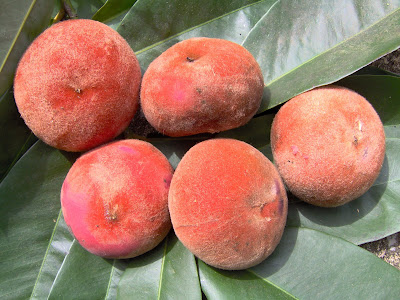
Velvet Apple/Mabolo(Gaab Fal)


Velvet Apple/Mabolo(Gaab Fal)

A cross section of a Velvet Apple/Mabolo(Gaab Fal)


Velvet Apple/Mabolo Fruit Flash(Gaab Fal)

Velvet Apple/Mabolo Leaves(Gaab Fal o Gaab Gaaser Paata)
 

        Velvet Apple/Mabolo Tree(Gaab Fal Gaas)

Velvet Apple/Mabolo is known in Bangladesh as Gaab Fal . Its scientific
name is Diospyros blancoi .Family is Ebenaceae and Genus is  Diospyros .
Velvet Apple/Mabolo (Gaab) is a medium sized large evergreen tree growing to
 a hight of 20 meter.The oblong-acute leaves are 10 to 25 cm long .The leaves
are glossy green ,smooth above and soft hairy below .Femel flowers are axillary
and solitary ,larger than male.Fruits are fleshy,globose ,upto 8-10 cm diameter,
densely covered with short brown hairs.The fruit's flash is soft ,whitish and aromatic.


Friday, 11 February 2011

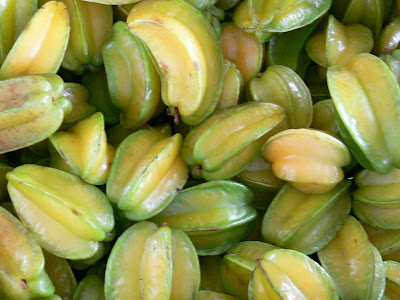
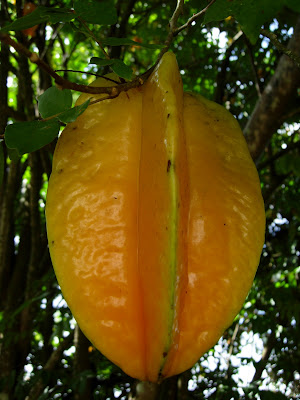
Carambola /Star Fruit (Kamranga Fal)


Carambola /Star Fruit (Kamranga Fal)

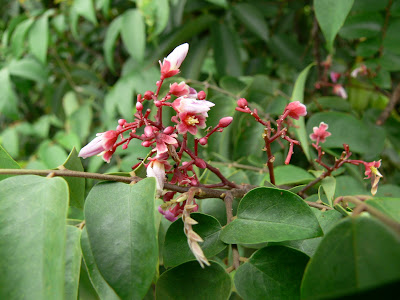
Carambola /Star Fruit's Flower (Kamranga Ful)
Kamranga Flower
Carambola /Star Fruit's Flower (Kamranga Ful)

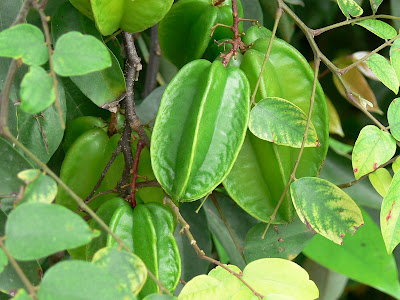
Carambola /Star Fruit (Kamranga Fal)
AF0400 Averrhoa carambola star fruit 5 seeds
Carambola /Star Fruit Tree (Kamranga Fal Gass)

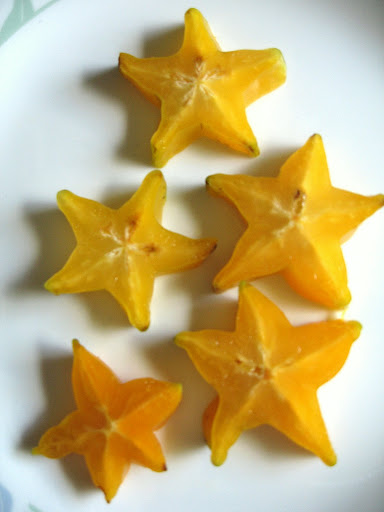
A cross section of a Carambola /Star Fruit (Kamranga Fal)


Carambola /Star Fruit is known as Kamranga in Bangladesh.Its
scientific name is Averrhoa Carambola and Family is Oxalidaceae.
Carambola /Star Fruit (Kamranga Fal) is a  slow growing small tropical tree,
no more than 8 meters tall. The green leaflets of this tree are sensitive to light
and fold inward at night. It has small, pink colored flowers with a dark-red heart.
The carambola/Star Fruit (Kamranga Fal)  plant will flower and fruit four
times yearly. This tropical fruit, fleshy five lobbed, ovate to elliptoid, is
attractive yellow-orange and pleasantly aromatic! The tree flowers and fruit
almost year-round. When sliced in cross section a perfect star is formed. Carambola
is eaten fresh or in fruit salads. The carambola tree seems to be used for bonsai.