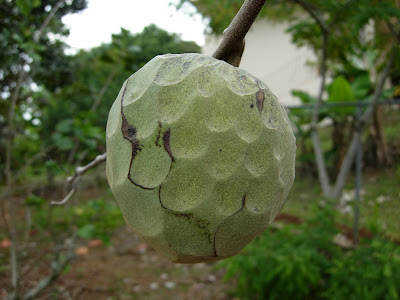
Thursday, 17 March 2011

Bangla language, it's achievement and now one of the official language in Sierra Leone


Bangla speaking rigion in yellow colour

Number of Bangla Speakers : Bangla or Bengali (বাংলাpronounced bang-laa; baŋla) is an eastern Indo-Aryan language. It is native to the region of Eastern South Asia known as Bengal , which comprises present day Bangladesh . Bangla is the mother tongue of the people of   Bangladesh .About 160 million people live now in Bangladesh. The Indian states West Bengal, Tripura, Assam-mainly southern Assam and other places of India also people speak in Bangla as their mother tongue . It is even a major language in the Indian union Territory of Andaman and Nicobar Islands(Bengali speakers make up the majority in Neil Island and Havelock Island) due to lot of settlement post 1947 migration. Now a days we can count the Bangla speaking population in India on an average 90  million .Outside Bangladesh and India, Bangla is spoken in Nepal by over 27000 people and to a lesser degree in Singapore, Malaysia, Saudi Arabia, United Arab Emirates,South Korea ,the United Kingdom,Canada and the USA .Across all countries where it is spoken an additional 5 million people speak Bangla as a second language. With nearly 255 million total speakers, Bangla is one of the most spoken language – ranking sixth (efter Mandarin, Spanish, English, Hindi and Arabic) in the world.

Bangla alphabets
 Bangla Script Uses in other Languages : The Bangla script has particularly close historical relationships with the Assamese script.With a few small modifications Bangla script is also used for writing Assamese.Other related languages in the region also make use of the Bangla alphabet. Meithei (Manipuri),a Sino-Tibetan language used in the Indian state of Monipur, was written in the Bangla alphasyllabary for centuries, until the 1980s, when Meetei Mayek (the Meithei alphasyllabary)returned to daily usage. For centuties, the Sylheti language used a different script, based on the Devanagari alphasyllabary. This script called Syiheti Nagori, has now fallen out of use, as most speakers of Sylheti have adopted the Bangla script .Even in Tripura(Indian States) another major language Tripuri also known as Kak- Barak, belongs to the Tibeto-Burman group of languages(root can be traced from Sino-Tibetan speech family) does not possess any writing script. This language also uses the Bangla script for writing.
Spread of Bangla, Official Status and achievement : Bangla is the national and official language of Bangladesh. Bangla is also one of the 23 national languages recognized by the Republic of India. It is the official language of the state of West Bengal and co-official language of Tripura, Assam which has three predominantly Sylheti speaking districts – Cachar, Karimganj and Hailakandi of southern Assam and the union territory of Andaman and Nicobar Islands.

File:Ahmed Tejan Kabbah.jpg
President Alhaj Ahmed Tejan Kabbah

It is also remarkable that the government of Sierra Leone  declared Bangla as one of the several official languages in the country. On the 12th December, 2002 the President of Sierra Leone Alhaj Ahmed Tejan Kabbah(born February 16, 1932 ;3rd President of Sierra Leone, serving from 1996 to 1997 and from 1998 to 2007. He worked for the United Nations Development Programme and returned to Sierra Leone in 1992.) announced this decision while inaugurating a 54 km long rebilt road. This road was reconstructed by the engineering corp of Bangladesh Army – Bangladeshi peacekeepers in the West African country. So Bangla was made an official language of Sierra Leone in order to honor the Bangladeshi peacekeeping force from the United Nations stationed there.
 
Language movement martyrs sculpture
When from 1947 to 1971 Bangladesh and Pakistan were one nation(and were called East and West Pakistan), the central government tried to establish Urdu(spoken in West Pakistan)as sole national language.On February 21,1952,protesting students and activists were fired upon by military and police in Dhaka University and several students and activists were killed. But the government had to give in after massive protests and gave Bangla official status.

 
Language martyrs monument-Shaheed Minar
In 1999,UNESCO decided to celebrate every 21 February as International Mother Language Day in recognition of the deaths of the language martyrs.
And at last I like to say that Rabindranath Tagore(1861-1941), the first Asian author who won the Nobel Prize in Literature was a Bangali poet and writer, wrote the national anthems of both India and Bangladesh in Bangla.

S:en.wikipedia.org;mybengali.com;joutho.wikidot.com;bangladeshcanadaandbeyond.blogspot.com; voanews.com(27-12-2002);bangalnama.wordpress.com/2008/09


Tuesday, 15 March 2011

Jambul(Jaam/Jam/Kalojaam) is one of the desirable summer fruit in Bangladesh

Ripe Jambul/Jamun or Jambolan (Jam/Jaam /Kalojaam)

Ripe Jambul/Jamun or Jambolan (Jam/Jaam /Kalojaam)


Green and ripe Jambul/Jamun or Jambolan (Jam/Jaam /Kalojaam)

 Jamblang/Jambula or Black plum(Jam/Jaam /Kalojaam) in the tree


Jambul/Jamun or Jambolan (Jam/Jaam /Kalojaam) leaves


 Jamblang/Jambula or Black plum(Jam/Jaam /Kalojaam)hanging in the tree

 Green and ripeDuhat Plum,Java Plum or Portuguese Plum(Jam/Jaam /Kalojaam)


 Jambul/Jamun or Jambolan (Jam/Jaam /Kalojaam) flowers

Blooming Jambul/Jamun or Jambolan (Jam/Jaam /Kalojaam) flowers

Yielding Jambul/Jamun or Jambolan (Jam/Jaam /Kalojaam)and flowers

Green young Jambul/Jamun or Jambolan (Jam/Jaam /Kalojaam) fruits

Green and mature Jambul/Jamun or Jambolan (Jam/Jaam /Kalojaam) with leaves

Ripe Duhat Plum,Java Plum or Portuguese Plum(Jam/Jaam /Kalojaam)


Jambul/Jamun or Jambolan (Jam/Jaam /Kalojaam) seeds


Jambul/Jamun or Jambolan (Jam/Jaam /Kalojaam) tree bark

Jambul/Jamun or Jambolan (Jam/Jaam /Kalojaam) tree trunk and leaves


A line of Jambul/Jamun or Jambolan (Jam/Jaam /Kalojaam) trees


A short size Jambul/Jamun or Jambolan (Jam/Jaam /Kalojaam) tree

A vendor on a roadside with Jambul/Jamun or Jambolan (Jam/Jaam /Kalojaam)
Ripe Jambul/Jamun or Jambolan (Jam/Jaam /Kalojaam)


Jambul/Jamun or Jambolan is known as  Jaam /Kalojaam in Bangladesh. This fruit is also known as Jamblang, Jambula, Black Plum, Damson Plum, Duhat Plum, Jambolan Plum,Java Plum or Portuguese Plum. Jambul/Jamun Or Jambolan (Jaam/Kalojaam) is  an evergreen tropical tree. It is native to Bangladesh, India and Indonesia region. It is also grown in other areas of southern Asia including Myanmar and Afghanistan. The word 'Jambul' is sometimes mistranslated as 'Blackberry', which is a different fruit. Its scientific name is Syzygium cumini and belongs to family Myrtaceae.
The tree was also introduced to Florida, USA in 1911, and is also now commonly planted in Suriname. In Brazil, where it was introduced from India during Portuguese colonisation, it has spread out in the wild in some places also. The various names for this fruit are (in Java) plum, jambul, jamun, jaman, black plum, Indian blackberry, jambol, doowet and jambolan.
According to Hindu tradition, Rama subsisted on the fruit in the forest for 14 years during his exile from Ayodhya. Because of this, many Hindus regard Jambul as a 'fruit of the gods'. In Hindu mythology Lord Krishna has been described as having skin the color of Jambul. The leaves are used in India as marriage pendals.
A fairly fast growing species, in native conditions it can reach heights of up to 25m and can live more than 100 years. Its dense foliage provides shade and is grown just for its ornamental value. Large oblong leaves are smooth, glossy, with a turpentine smell. Leaves are broad-tipped, opposite, shiny and leathery, ellipitic, 6 to 15 cm long. The Jamun tree starts flowering in March-April. The fragrant flowers of Jamun are small, nearly 5 millimetres in diameter. This is followed by the fruit which appears in May-June and resembles a large berry. The berry is oblongovoid and 1 to 2 cm long. It is green when just appearing, pink when as it matures, and shining crimson black when fully ripe. Jamun fruit is a mixture of sweet, slightly sub acid spicy flavour that stands out even after eaten since it turns the tongue into purple color. Its timber that is the wood of this tree is strong and water resistant. The fruit is universally accepted to be very good for medicinal purposes, especially diabetics. The seed is also used in various alternative healing systems like Ayurveda,  Unani and Chinese medicine for digestive ailments. The leaves and bark are used for controlling blood pressure and gingivitis.Wien and vinegar are also made from the fruit. The flowers have abundant nectar, and the honey is of fine quality. The essential oil distilled from the leaves is used to scent soap and is blended with other materials in making inexpensive perfume.
All parts of the java plum can be used medicinally and it has a long tradition in alternative medicine.The bark has anti-inflammatory activity and is used In India for anemia, the bark and seed for diabetes which reduce the blood sugar level quickly, the fruit for dysentery and leave's juice for gingivitis (bleeding gums).In the Philippines and Suriname wine is made from the fermented fruit.In Surinam also, the whole leaves are used by women as a feminine sitz-bath to shrink the vagina after giving birth and getting rid of mucus and odors. This bath from the Jamun leaves is also used at any other time to shrink the vagina. This gives the ultimate in sexual pleasure for both partners .
The tree occurs in the tropical and sub-tropical climates under a wide range of environmental conditions and can thrive on a variety of soils. Jambul grows easy in sub-tropics and tolerates cooler winters. It prospers on river banks and has been known to withstand prolonged flooding, yet it is tolerant of drought as well. Dry weather is even more desirable during the flowering and fruiting periods. The seedlings starts fruiting in 4-7 years.

The fruit has a high source in vitamin A and vitamin C, and has received recognition in folk medicine and in the pharmaceutical trade. The seeds, leaves and bark are also used in various alternative healing systems like Ayurveda and Chinese medicine.

S:  en.wikipedia.org; toptropicals.com; wonderherbs.org/syz.html; genuineaid.com

Thursday, 3 March 2011

Bangladesh has succeeded to save the world’s last one wild Tali Palm tree

Corypha taliera is a species of palm, native to Bangladesh region of South Asia. It is known as Tali Palm in Bangladesh. There was one last plant left of this extinct species, which was protected and grew in the scrub jungal on the Dhaka University campus, Bangladesh. The Tali Palm plant was discovered in the 1950s growing in the scrub jungle on the Dhaka University campus, Bangladesh. Professor Md. Salar Khan from the Department of Botany,Dhaka University, was first to identify a Tali Palm at the premises of the Dhaka University in 1950. He failed to identify in which species group  belongs to this palm tree. But he could understand that the plant may be a rare species. He took steps and appealed to the higher authority to save that plant and then subsequently protected in what became the enclosure of the residential quarters of the Pro Vice-Chancellor. In addition this species of tree was originally discovered in 1919 by William Roxburgh and considered endemic to Bangladesh.  
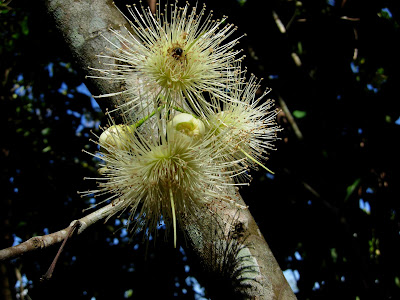
Corypha taliera or Tali Palm plant disappeared as it only flowers and bears fruit once its life and then dies.Tali Palm grows for say 80 years without producing a flower, then upon coming of age the flower grows out of the top of the tree, the leaves die and fall off leaving a massive terminal panicle flower atop the massive trunk. Corypha taliara or Tali Palm holds two world records which it shares with Corypha umbraculifera, the largest flower structure among flowering plants and the largest palmate leaf which is 6 meter(20 ft)wide.
The International Union for Conservation of Natural Resources(IUCN) classified Tali Palm plant on its Red List, as being ‘’extinct in the wild’’. No other specimen of Corypha taliera or Tali Palm Tree has been found in the wild in almost 30 years. In 1979, a Tali Palm tree , located in the Birbhum district of West Bengal in a village near Shantiniketan, had begun flowering. The locals fearing that it was a ‘’ghost palm tree’’ due to its horn-like flowers. Botanist Shamal Kumar Basu tried to motivate local people but failed. Local fearful people chopped it down before the flower could set seed. Then when he visited Bangladesh in 2001, he saw the Tali Palm treein the Dhaka University campus and identified it as the last one wild Tali Palm species.


When the 10 meter high Tali Palm tree at Dhaka University flowered in January 2010, students and academics stepped up their efforts to preserve the species with Arboriculture Department, collected seeds and produced  up to 500 samplings. University authorities had already distributed some plants aged over three months, in July 2010, among forest and arboriculture department of the government and other institutions.
Now we have good hopes of increasing the population and re-planting back of the Tali Palm plant into the wild.
S :The Khaleej Times, July 2010 ;The Daily Star, July 20,2010;Daily Prothom Alo, November 10 ,2008; Nature-Environment.com,October 21,2010;Rezowan.wordpress.com ;Wikipedia.org ;Trebrown.com/articles/blog
   

Sunday, 27 February 2011

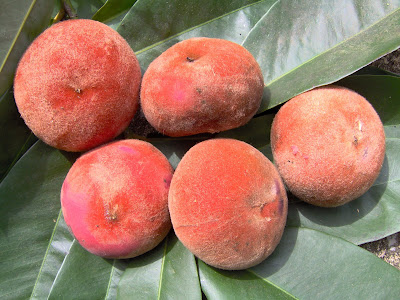
Velvet Apple/Mabolo(Gaab Fal)


Velvet Apple/Mabolo(Gaab Fal)

A cross section of a Velvet Apple/Mabolo(Gaab Fal)


Velvet Apple/Mabolo Fruit Flash(Gaab Fal)

Velvet Apple/Mabolo Leaves(Gaab Fal o Gaab Gaaser Paata)
 

        Velvet Apple/Mabolo Tree(Gaab Fal Gaas)

Velvet Apple/Mabolo is known in Bangladesh as Gaab Fal . Its scientific
name is Diospyros blancoi .Family is Ebenaceae and Genus is  Diospyros .
Velvet Apple/Mabolo (Gaab) is a medium sized large evergreen tree growing to
 a hight of 20 meter.The oblong-acute leaves are 10 to 25 cm long .The leaves
are glossy green ,smooth above and soft hairy below .Femel flowers are axillary
and solitary ,larger than male.Fruits are fleshy,globose ,upto 8-10 cm diameter,
densely covered with short brown hairs.The fruit's flash is soft ,whitish and aromatic.


Friday, 11 February 2011

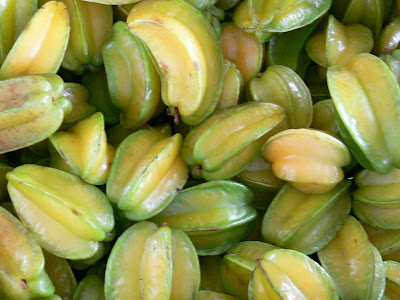
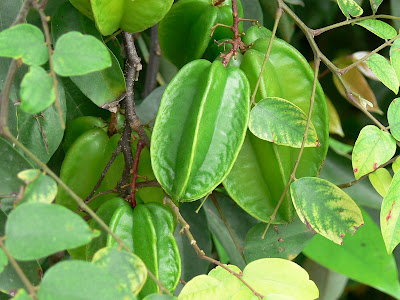
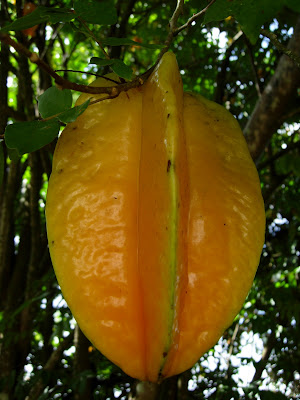
Carambola /Star Fruit (Kamranga Fal)


Carambola /Star Fruit (Kamranga Fal)

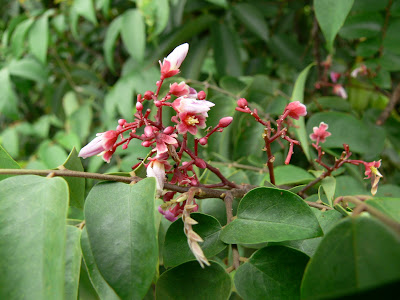
Carambola /Star Fruit's Flower (Kamranga Ful)
Kamranga Flower
Carambola /Star Fruit's Flower (Kamranga Ful)

Carambola /Star Fruit (Kamranga Fal)
AF0400 Averrhoa carambola star fruit 5 seeds
Carambola /Star Fruit Tree (Kamranga Fal Gass)

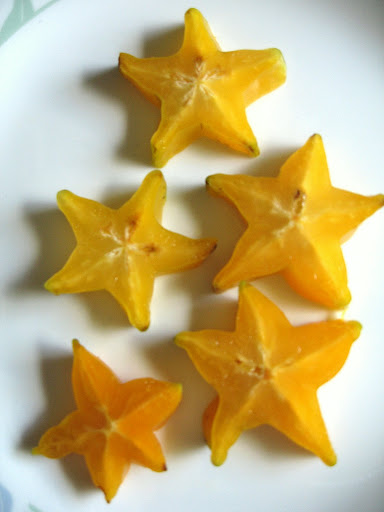
A cross section of a Carambola /Star Fruit (Kamranga Fal)


Carambola /Star Fruit is known as Kamranga in Bangladesh.Its
scientific name is Averrhoa Carambola and Family is Oxalidaceae.
Carambola /Star Fruit (Kamranga Fal) is a  slow growing small tropical tree,
no more than 8 meters tall. The green leaflets of this tree are sensitive to light
and fold inward at night. It has small, pink colored flowers with a dark-red heart.
The carambola/Star Fruit (Kamranga Fal)  plant will flower and fruit four
times yearly. This tropical fruit, fleshy five lobbed, ovate to elliptoid, is
attractive yellow-orange and pleasantly aromatic! The tree flowers and fruit
almost year-round. When sliced in cross section a perfect star is formed. Carambola
is eaten fresh or in fruit salads. The carambola tree seems to be used for bonsai.

Wednesday, 2 February 2011

Wax Apple/Water Apple(Jamrul Fal)

File:Wax apple1.jpg
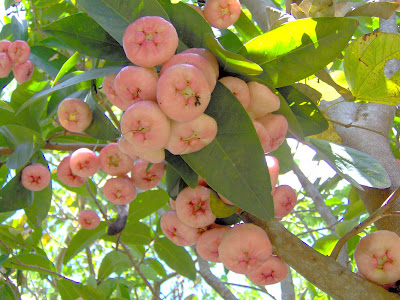
Wax Apple/water apple tree(Jamrul Fal Gass)

Wax Apple/water apple flower(Jamrul Fol)

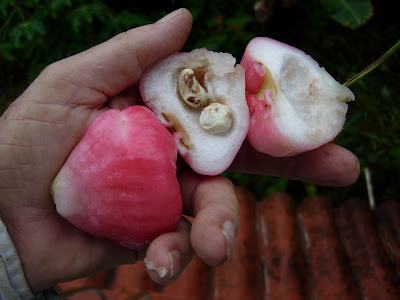
A cross section of a Wax Apple/water apple(Jamrul Fol)

Wax Apple/water apple tree(Jamrul Fal Gass)

Another variation of Water Apple/wax apple(Jamrul Fal)

Wax Apple/water apple flower(Jamrul Fol)

Another variation of Water Apple/wax apple(Jamrul Fal)

Wax Apple/water apple is known in Bangladesh as Jamrul Fal.Its scientific
name is Syzygium samarangense . Family is Myrtaceae and Genus is
Syzygium .It is a tropical tree growing to 12 m tall, with evergreen leaves
10–25 cm long and 5–10 cm broad. The flowers are white, 2.5 cm diameter,
with four petals and numerous stamens. The fruit is a bell-shaped edible berry,
with colors ranging from white, pale green, green, red, purple, crimson, to deep
purple or even black, 4–6 cm long in wild plants.

Sugar Apple/Cherimoya(Atta Fal)


Sugar Apple/Cherimoya(Atta Fal) flower

Sugar Apple/Cherimoya(Atta Fal)

A cross section of a Sugar Apple/ Cherimoya(Atta Fal)

Another type of Sugar Apple/Cherimoya(Atta Fal)

Sugar Apple/Cherimoya(Atta Fal)

Sugar Apple/Cherimoya(Atta Fal) leaves and flowers
In some regions of the world, the Sugar Apple in bangla Atta Fol is also known as custerd-apple or cheri moya. Scientific name of this fruit is Annona  squamosa , Family is Annonaceae and Genus is Annona. It is a semi -evergreen shurb or small tree reaching 6-8 meters(20-26ft) tall. The leaves are 5-17 cm long and 2-5 cm broad. The fruit is usually round, slightly pine cone-like, 6–10 cm diameter and weighing 100–230 g , with a scaly or lumpy skin. There are variations in shape and size. The fruit flesh is sweet, white to light yellow, and resembles and tastes like custard. The edible portion coats the seeds generously. There may be a total of 20 to 38 or perhaps more seeds in the average fruit.